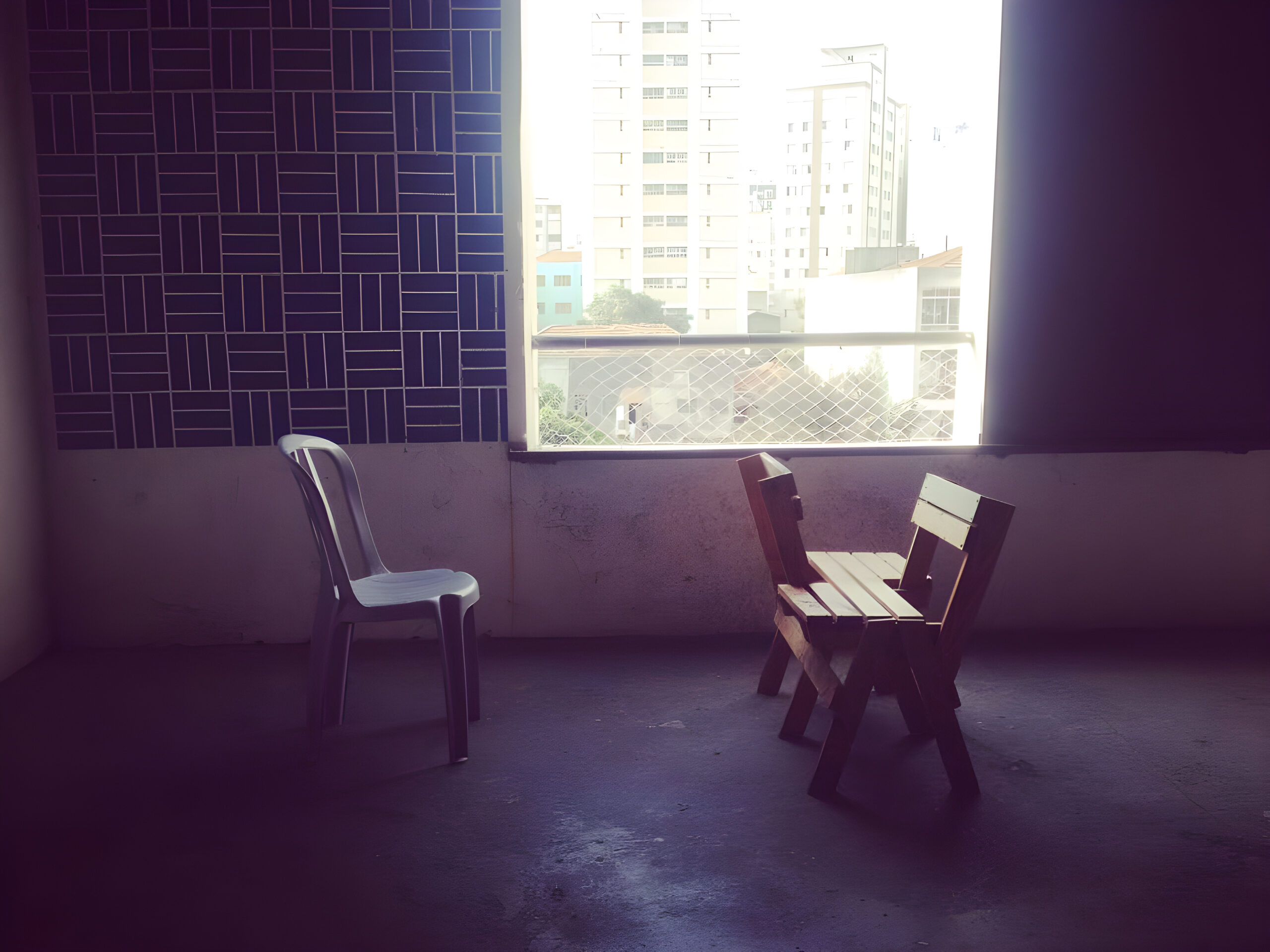

This creative presentation emerges from an ongoing reflexive writing group attended by three Professional Doctorate in Social Work candidates at the Tavistock. Our recent collaborative thinking has focused on Black women’s anger as psychosocial, political, and relational phenomena.
For our contribution to Space 6 of the FREEPSY conference, we, therefore, propose a live conversation between the three of us; a spontaneous, unscripted dialogue of our reflections on anger and rage in our lives and experiences as Black women who have different diasporic identities.
Inspired by FREEPSY’s invitation to “un-do” Freud’s couch, we replace the analytic couch with ourselves occupying three chairs arranged around an empty fourth chair, which represents the ever-present histories of psychoanalysis, colonialism, racism, politics of Black womanhood, rage, silence, and survival. Together we explore and hold the tensions, contradictions and solidarities that exist in our experiences of anger. These experiences resonate differently in each voice yet weave a solidarity in love and sisterhood.
The presentation will unfold primarily through this dialogue; however, we will supplement our conversation with a display of creative artefacts which evoke our embodied and sensory expressions of anger. We would like this part of our contribution to be included in the Living Conference Space.
For audiences, this is not merely an opportunity to vicariously listen to Black women speak about anger. It is an invitation to enter the space where bearing witness is a prerequisite. We hope that through collective witnessing the audience, along with us, can consider anger’s potential for generating a foundation for clinical, political, and creative practice.
Through this, we firmly place psychoanalysis in Black and Transnational Feminist, anti-racist and anti-colonial contexts.
May, 2020: George Floyd was murdered on the block where I worked as a housing organizer, in an office shared with a labour organizing organization in South Minneapolis. In the years since, George Floyd Square has remained a memorial and an evolving social space where grief, conflict, mutual aid, political imagination, and collective care continue to unfold. Approaching this history as a community organizer, filmmaker, and aspiring psychoanalyst, this project asks what psychoanalysis might learn from public listening and whether an uprising can itself become an analytic setting.
The session consists of a five-minute documentary followed by a fifteen-minute presentation and discussion. The documentary combines archival footage, images, ambient sound, oral histories, and neighbourhood observation to construct a cultural history of George Floyd Square and its afterlives. It traces the Square’s significance—including community responses to renewed immigration enforcement in 2026—to explore how mourning, vigilance, memory, and solidarity become woven into everyday neighbourhood life. From the perspective of an organizer and filmmaker, the film investigates forms of listening practiced within the community before asking what psychoanalysis might contribute to them.
The accompanying presentation places the film in dialogue with histories of free psychoanalytic clinics and contemporary work on territorial listening. Speaking from my roles as organizer, filmmaker, and aspiring analyst, I ask not how psychoanalysis might explain political upheaval, but what psychoanalytic listening would have to become to participate within it. What distinguishes analytic listening from other practices of care? How might concepts such as mourning, transference, and collective psychic life illuminate spaces where communities gather to bear witness, remember, and organize?
The discussion invites participants to imagine what a free psychoanalytic clinic, grounded in territorial listening and working alongside mutual aid infrastructures, might contribute during moments of political rupture.
As part of the ongoing LISTENINGS project (PPS/University of Essex), this proposal seeks to expand an artistic archive to symbolically reconfigure the listening offered to queer migrants, this time through an open call for an exhibition to be held during the FREEPSY Conference. Rather than conceiving the archive as a repository of completed histories, the project understands archiving as a psychosocial practice of listening that makes visible forms of experience frequently excluded from normative regimes of recognition. Drawing on psychoanalysis, psychosocial studies, queer theory and decolonial thought, the project assumes that artistic practices actively produce alternative symbolic conditions through which displacement, memory, desire, belonging and loss can be encountered, and that these conditions may also expand our clinical horizons. In this sense, artistic archives become sites of counter-listening: spaces that interrupt dominant narratives of credibility and identity while opening new possibilities for collective imagination, thereby fostering greater theoretical and clinical elasticity in psychosocial practice. The aim is to launch an open call inviting queer artists with migration backgrounds to contribute visual artworks suitable for digital exhibition and print display. The guiding question for the call will be: Who listens when stories cannot be translated into institutional categories? Who listens when desire exceeds the languages of identity, credibility and recognition? The exhibition invites visual works that explore symbolic configurations challenging the normative frameworks of borders, highlighting alternative possibilities for queer diasporic life, with particular attention to futurity and care as radical acts. Selected works will form a freely accessible virtual archive, available via QR codes and in a partner online platform (muq) and will also serve as the starting point for future exhibitions and collaborative research initiatives. The proposal invites conference participants to become collaborators in constructing a living archive, fostering networks among artists, researchers, clinicians, and community organisations working at the intersections of migration, queer experience, and psychosocial practice.
I feel the impossible stories pressing on my body. I feel them writhing formlessly in my stomach, deadening the breath in my throat and chest. To reach these stories, to attempt to transcribe even a part of them, I need to imagine, to dream, to sit in silent agony, letting my body speak for me and to me.
These embodied imaginings sometimes reveal the shape of an impossible story that could be transcribable into language. But telling the story could have consequences. What will happen if I write of my own madness? My shameful desires? My queerness? The stories of queer patients in psychotherapy have rarely been told by the patients themselves.
The Greek fable – often known as an ‘Aesop’s fable’ – is ‘a brief and simple fictitious story with a constant structure, generally with animal protagonists, which gives an exemplary and popular message on practical ethics and which comments, usually in a cautionary way, on the course of action to be followed or avoided’ (Vaio & Zafiropoulos, 2003, p. 1). In Aesop’s fables, the fox is a trickster, the crow is vain and stupid, the old woman is wise but barren, the young woman is both desirable and a threat to men. These archetypes are powerful, but also enshrine normative beliefs about acceptable and unacceptable behaviours, acts, relationship structures, and desires.
Drawing on the rich traditions of speculative fabulation (Haraway), critical fabulation (Hartman), and Afro-fabulation (Nyong’o), this contribution to ‘Space Otherwise’ re-tells the Aesop’s fable of the fox and the crow, queering its power dynamics and relationship structures. I invite the audience to consider what truth about a queer patient’s experiences in psychotherapy might be contained within this ‘most profound fiction, at the heart of the real’ (Deleuze, 2012, p. 149).
This essay introduces the concept of “inoutside” to think about what happens when the line between inside and outside no longer holds. It begins from a lived wartime experience in which sirens, ambulances, missiles, maps, and the feeling of safety become mixed together in the narrator’s mind. In this condition, “outside” is no longer simply somewhere beyond the borders of Iran. Instead, it becomes something stretchy, unstable, and mobile, something that travels with the self and troubles the fantasy of a clear division between here and there.
Through a series of drawings, the essay develops “inoutside” not as a third space between inside and outside, but as the failure of their separation. “Inoutside” names a threshold where borders leak, where something can be accepted and rejected at the same time, and where what does not fit dominant visual and political orders is quickly called ugly, incomplete, or wrong. The essay also reflects on the limits of AI image generation, showing how image models struggle to represent the space between borders because they can only recognize what already fits familiar categories.
In its final movement, the essay turns to Freud’s concept of drive to suggest that “inoutside” can also be understood as a spatial and political version of a psychic condition in which inner and outer pressures cannot be cleanly divided. From this perspective, hatred appears as a reaction to what does not fit expected forms — an attempt to destroy fragile and unknown possibilities. Against wartime logic, which demands naming an enemy and casting it out, the essay asks whether survival may also depend on another movement: taking in, stretching, and making room. “Inoutside” becomes the name for that unfinished possibility.
