
Building a raft of/for the Free Clinics Network

Free psychoanalytic clinics around the world have created rich visual languages through their online and social media presences, speaking to the clinics’ orientations towards structures of power, theory, and potential patients and collaborators. In February 2026, the FREEPSY research team gathered in Islington, London, together with network facilitator Susana Caló, research assistant Harriet Mossop and designer Hugo Coria, to listen collectively to this visual language. As preparation, we downloaded social media and web images from a selection of the 250 clinics. With the recent FREEPSY newsletter The Transgender Issue in mind, we selected a ‘cut’ of around 400 images from 14[1] clinics in different countries that have a visible orientation towards LGBTQIA+ patients.

We immersed ourselves in these images before the workshop. We immediately became overwhelmed: how to choose which images to spend time with? Those that are visually pleasant, or somehow represent a free clinic? Some of the text – in different languages – was not immediately comprehensible, or related to topics that we didn’t feel familiar with. Despite this overwhelm and confusion, each of us gathered some initial thoughts to share with the group at the beginning of the workshop.
Layer I – initial sharing of images and associations
We each selected images from the clinics and shared some initial associations. These associations appear below as shared writing, a collective initial response to the free clinics’ visual world:


The free clinic images called to mind nodes of communication, a spider sitting in a nook, waiting to feel vibrations in its web. Communication occurs without language, to and from the margins of the network. Might the idea of the raft help us to overcome the problems of contributing to an international network? Despite the bright pastels of the social media images, there were glimpses of darkness, tangles of relationality, an irreducible materiality. We didn’t know whether to trust the smiling faces depicted in many images, and noted the presence of black women – often missing in mainstream psychoanalytic spaces. We wondered, what sort of images are being shown on Instagram, and who is the audience? We noticed different tropes from the Global North and the Global South, which sometimes seem like different planets. Different countries have different regulations and conventions about what can be depicted in social media – for example, do children appear? We wondered about the gaps between images and reality – the clinic might be a short-term project or a long-term endeavour. Some clinicians feel less comfortable sharing social media images, and data protection regulations can be suffocating. We felt that we needed to dig deeper behind the images, which sometimes showed bizarre combinations: Ferenczi and Winnicott with Preciado and a flower. We wondered about images that are over-used and become tropes – such as the iceberg model of covert and overt racism, and jokes. Why do some clinics show Freud’s face, whilst others don’t feel the need to show his presence? We saw evidence of a decomposing psychoanalysis – a black man on the couch with the foregrounded psychoanalyst’s hand was flattened out in an AI reading as a guy chilling out on a cosy sofa. Once again, we felt lost, bombarded by constantly changing visualisations in different languages. But the opening and closing of different images felt somehow alive, tangled, messy, layered. What should we do with these tangles? Should we share the images, create something from them, contribute something, delete something?
Layer II – Free writing in response to initial associations
In the next part of our layered workshop, we sat at tables at the edge of our meeting space, facing in towards each other. There were three sheets of A5 paper on each table. We wrote (in any language) and drew in short bursts of 3-4 minutes, changing tables after each sheet of paper was filled. Each table quickly formed three layers of responses to the free clinics’ images and to the initial verbal associations, in separate but inter-related journeys. We assembled the free writing on a large, central table: the beginnings of a raft.


Layer III – Individual Collage
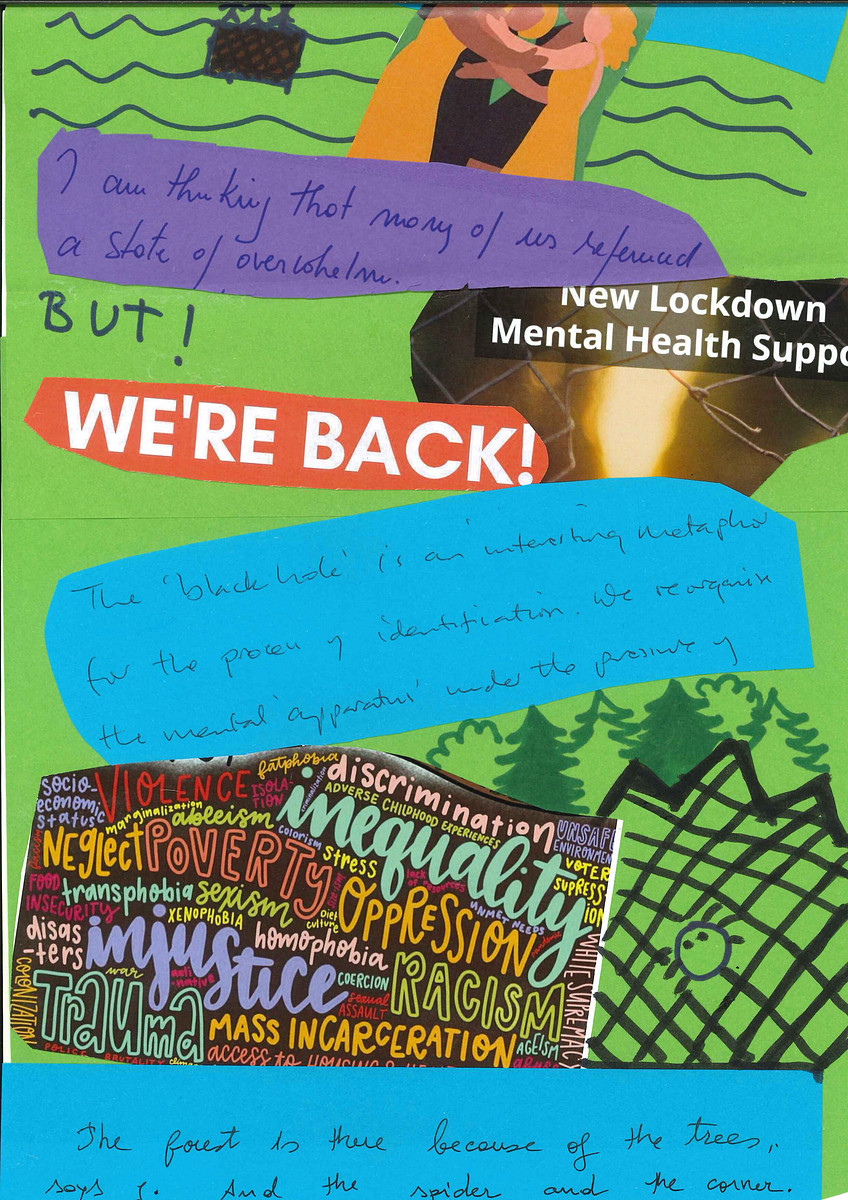
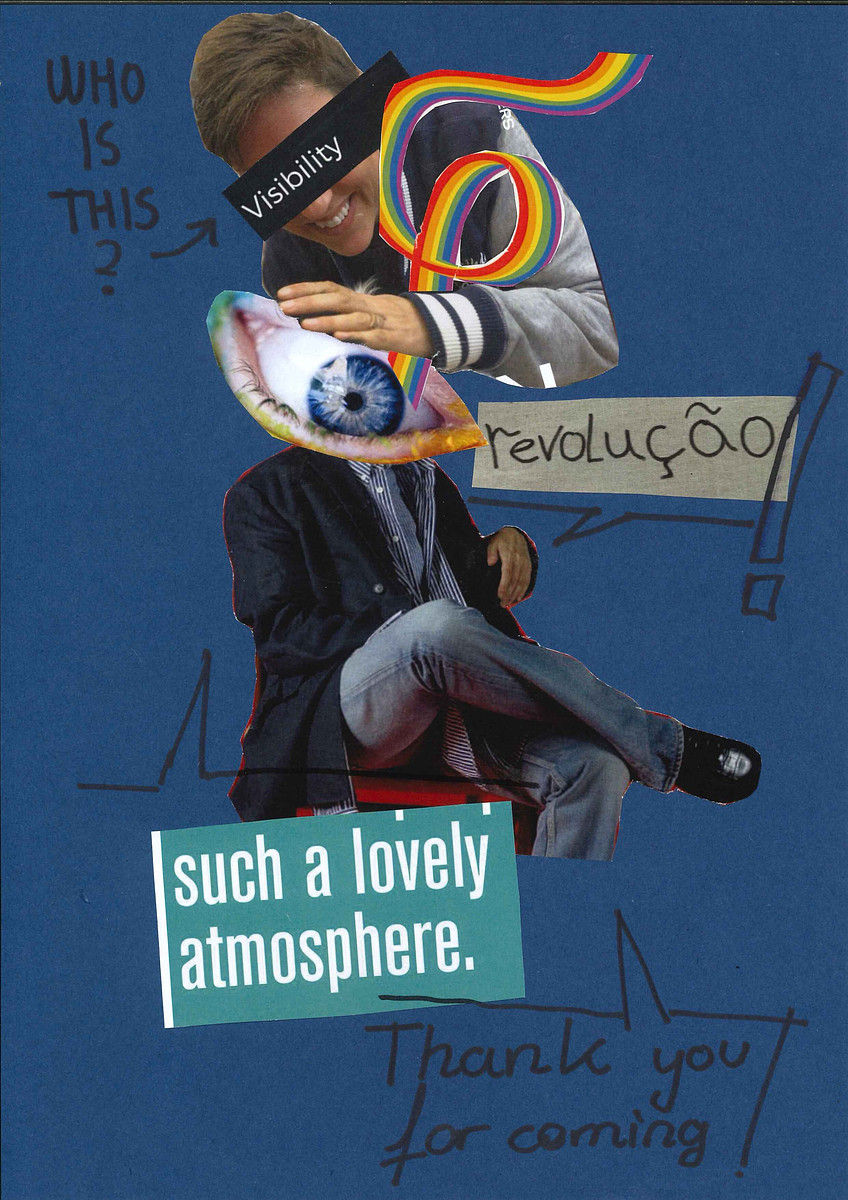
On the larger table, we also placed around 400 images from the 16 free clinics that showed traces of working with LGBTQIA+ patients in their social media feeds. We each selected print outs of these images, as well as any of the free writing that caught our attention, and sat again at individual tables with scissors, paper and glue, to make collages.
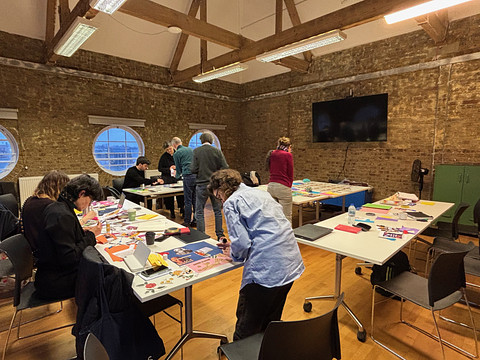


While the collages were being made, the other crucial element of the raft was being assembled: a flimsy frame made of tomato sticks from Harriet’s East London garden and knitting wool. The timing felt fraught: would the frame be ready in time for the collages? Would everyone be able to produce something to place on the raft?
Layer IV – Building the raft
Once the collages were complete, we brought them back to the large table. We spent time looking at them: free clinic images from around the world, transformed in time, space and materiality, reassembled on one table in London. We started to place the collages and free writing text on the frame, to build the raft. Which images spoke to each other? Which were in tension? Groupings began to emerge, and were symbolised by tentative webs of kitting wool and Sellotape. There wasn’t space for everything on the raft, and we became anxious about contributions that were placed to one side. Would they be swept away by a wave, never to be seen again? Would the raft hold together if we tried to move it? We stood, looking at the raft, reflecting on this strange creation, and on the process of making it.

Afterwards, we disassembled the raft, disconnected the tomato sticks from the knitting wool, and packed it all away. The raft only exists, now, in virtual form, like the images that it was constructed from. It’s brief existence as a material object has dissolved beneath the waves.
By Harriet Mossop, FREEPSY Research Assistant
[1] Afetiva Rede de Cuidado, Brazil; Albany Trust, UK; Black Psychotherapy, UK; Casa Chama Psi, Brazil; Clini Cuz, Brazil; Coletivo Intervencao, Brazil; ELOP, UK; Fala Trans, Brazil; London Friend, UK; Metro, UK; Projecto Sobreviver, Brazil; Rede Divam, Brazil; Red Feminista Trans, Refugio Muenchen, Germany.

